Friday, November 27, 2009

Campaign Move 4


Battle of Naumburg
0800 - 1200 3 June 1813


Campaign Map to Wargames Table


Campaign background

At first light on the morning of 3 June 1813 general Sacken was approaching Naumburg on the east bank of the river Saale, when he received reports from his cavalry screen that French cavalry had crossed the river and were approaching the town from the west. He ordered his cavalry to contain the enemy and discover what was behind the cavalry screen

The French cavalry was a brigade of chasseurs, the advance guard of the 1st corps, the Imperial Garde. Napoleon was not present, and the decision whether to fight or not rested with general Friant. Without hesitation he ordered his corps to cross the bridge and advance on Naumburg, the cavalry would hold their ground to cover the crossing.

French Order of Battle

1 French Corps General Friant (G)
1 Infantry Brigade CA FB SB
2 Infantry Brigade CB FB SB
3 Infantry Brigade CB FC SB
4 Infantry Brigade CC FC SC
1 Cavalry Brigade CA Light
1 Foot Artillery CA 12 pounder

Russian Order of Battle

2 Corps General Sacken (A)
5 Infantry Brigade CA FB SB
6 Infantry Brigade CB FB SB
7 Infantry Brigade CB FC SB
8 Infantry Brigade CC FC SC
2 Cavalry Brigade CB Heavy
Corps Artillery CB 12 pounder

Wargames Table

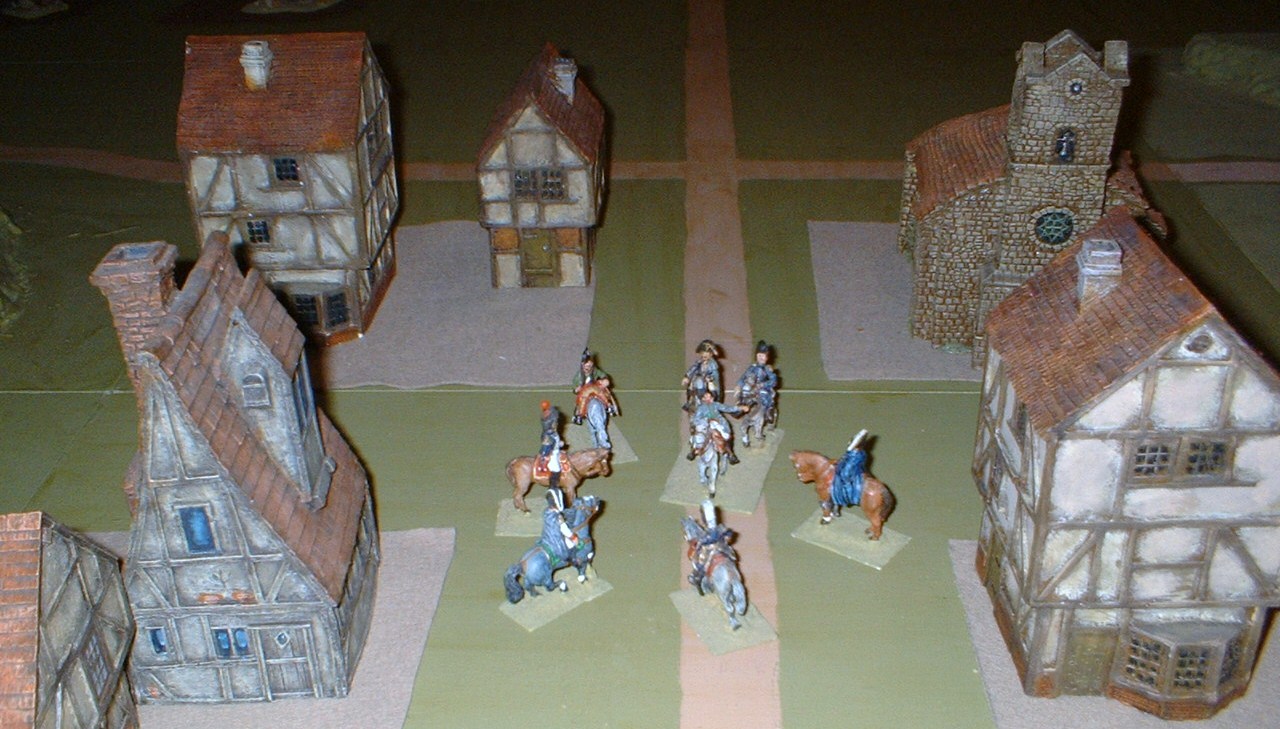
The town at the crossroads is Naumberg. The top road leads to Halle and the bottom to Gera. The road on the right is from Zeitz and on the left to Weimar. The river is the Saale. The terrain is open and flat except for one hill to the west of the Gera road.

The Russians are approaching the town from the right along the Zeitz road, their cavalry are south of the town observing the French advance

The French are just starting to cross the river, and their cavalry are deployed to protect the crossing from the enemy cavalry

Thursday, November 26, 2009

Campaign Move 8


Campaign Diary

1200 to 1600 3 June 1813


Campaign map at start of battle

1st French corps cross the river Saale and approach Naumburg. Their cavalry immediately clash with cavalry from 2nd Russian corps. Both sides have orders to occupy the town, which results in the first battle of the campaign.

Tuesday, November 24, 2009

Campaign Move 7


Campaign Diary
0800 to 1200 3 June 1813


French corps approach river Saale


French cavalry cross river Saale and move eastwards. They are soon in contact with Russian cavalry and deploy but await further orders. Napoleon is too far to the rear to take personal command of the situation, and the decision whether to engage is left to the corps commanders on the spot.


Campaign Move 6


Campaign Diary
1600 to 2000 2 June 1813


Napoleon meets with his corps commanders in Erfurt


Napoleon is reported to have arrived in Erfurt. The main road from Fulda is crowded with military supply convoys and large numbers of marching troops all heading east. All post houses and local government buildings have been taken over by the French authorities, and all mail seized.

Sunday, November 22, 2009

Campaign Move 5


Campaign Diary
1200 to 1600 2 June 1813


French corps nearing Erfurt


French troops entered Erfurt and imposed a curfew on the civilian population. Despite this there are reports of wide spread looting and abuse of civilians. Throughout the surrounding countryside French patrols are collecting food and material from villages and farms. Despite this the local population are understood to prefer the presence of French to Russian troops.


Saturday, November 21, 2009

Rule 5 - Campaign Messages


There has been some cavalry contact today, and it has highlighted how necessary it is to write your emails with care.

You will all be aware that each day is divided into three sections. Each of those sections is a move in the campaign. You will see if you look at the campaign diary that Move 1 is 0800 1 June 1813

When you write a a report or send an order you should always put on it who it is from, the date and time it is sent and the location it is sent from. You should also put who it is addressed to.

I have sent cavalry contact reports to corps commanders and then been asked what time they receive the message. You can assume that all mail is received within the same move that it is sent. However your reply will be at the start of the next move. For example if you receive a report dated 0800 1 June your reply should be 1200 1 June. In other words it is sent in Move 1 and your reply will be sent in Move 2.

If you receive a report from your cavalry commander the reply should be sent to him, and possibly new orders issued to your corps. These should be sent to me as umpire. If you want to notify your cinc, or an adjacent corps commander, these should also be sent to me, as there may be a time delay imposed. Don't forget that I am your corps chief of staff, so in fact you are giving your chief of staff a message addressed to your cinc or adjacent corps commander.

It is very important that you stick to these rules. There are a lot of email going around, and they are all either addressed to me, or copied to me. It is essential that we all understand who they are from and who they are addressed to, plus the time and place they are sent from.

If you have a general query for me then just send a normal email - no need for all of the above.

Friday, November 20, 2009

Campaign Move 4


Campaign Diary
0800 to 1200 2 June 1813


1 Russian corps enter Leipzig


Large crowds of civilians left Leipzig and headed for Halle as the Russians approached the city. The King of Saxony has declared that he will remain neutral during this campaign, but that has not stopped the Russian Cossacks from creating havoc amongst the civilian population. Nor taking possession of Leipzig There are reports that Leipzig contained large amounts of military stores and equipment, which is now in Russian hands.